Toguna. Meeting place for the men of the village, to discuss important matters. There is no height to stand up and argue!


The blacksmith’s house.

He performs the circumcision. Males and females are thought to be born with both sexual components. The foreskin is considered female, while the clitoris is considered to be male.


Menstrual hut. Women must not live with their families and work at home when they have the period. What do you think?


mosque


Party in Bandiagara


Djenne:


In the IXth century, as the town was being constructed, malevolent spirits caused the buildings collapse. The marabout explained that the spirits were angry because of the animist believes that their ancestors had practiced for centuries before they converted to Islam. In order to please them they must perform a sacrifice. Nobody offered herself as a volunteer and the marabout decided to sacrifice his own daughter to be buried alive.


Moroccan traders built their houses in Moorish style. The top part was for the masters, the middle floor for the slaves and the bottom floor for storage. Houses have little windows. This way women could look to the street without exposing themselves.


Searching the sacred well of Nana Wangara, where women pray when they want to get pregnant. During the Moroccan occupation of the city, the Moroccan ruler built this well so that his favourite wife would not meet the other concubines when she collected water. Besides, the water of the well would reflect the future and even cure illnesses.


Helga and I are having some coucous for dinner. Suddenly we hear some drums coming towards us. There is a wedding celebration in the street! A woman pulls my arm, oh, I am dancing in front of everybody! They clap their hands and smile :-)


Helga's house. This is the palace where I have spent the last two nights. The rain would not let me go out.


Women carry their babies tied to their back. The poor baby had been crying for some time while his mother moved working and I took it :-)


Before I came to Mali I had been reading about the sights I will visit. But I feel completely open to learn from the people I can find on my way. I met Helga, a volunteer from Belgium who cooperates with an NGO that is teaching English.


Many parents in the village did not deem it important for their children to go to school. The organization started to distribute a plate of rice after every lesson, three times per week. Now many parents send kids to school. Before this children ate rice three times per week most of them suffered from malnutrition. Now it is obvious Their situation improved


Helga's friend Abba took us on a boat trip with his kids.


Peul village


The Fula, Fulani or Peul constitute a large and disperse group. They were nomadic pastoral groups.


Women are responsible for caring for the cattle, while the men are involved in agriculture.


I think musulman societies don't show affection physically in public. Malians they simply never kiss, neither in privacy. Mothers don't kiss children's faces, so they don't understand what a kiss is. It was so much fun for them to try!

A Bozo village:


the mosque of the village:


The Bozo are Muslim, yet they preserve a number of Animist traditions including masquerade.


Fishing is the responsibility of the Bozo men and boys. The women raise rice and vegetables that they sell in the market.


Have you ever seen yourselves in a photo?


The Bozo people are highly skilled fishermen. They stand on the end of long narrow pirogues to cast their nets onto the waters of the Niger River.


Au revoire!


Can you see the cows crossing the river?
Another Bozo village


Bozo society is patriarchal. It is common for some men to have more than one wife, sometimes in different cities.
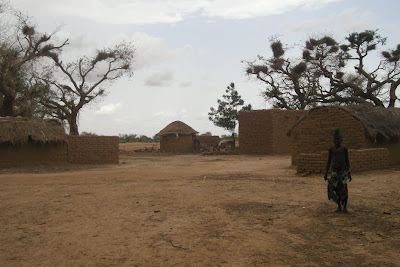


Helga's friend took to villages where turists don't show. People were curious and nice, all of them wanted to shake hands when we greeted them in their language. The youngest kid bursted into tears when he saw white people. The closer we got the more he cried, until run away frightened.